
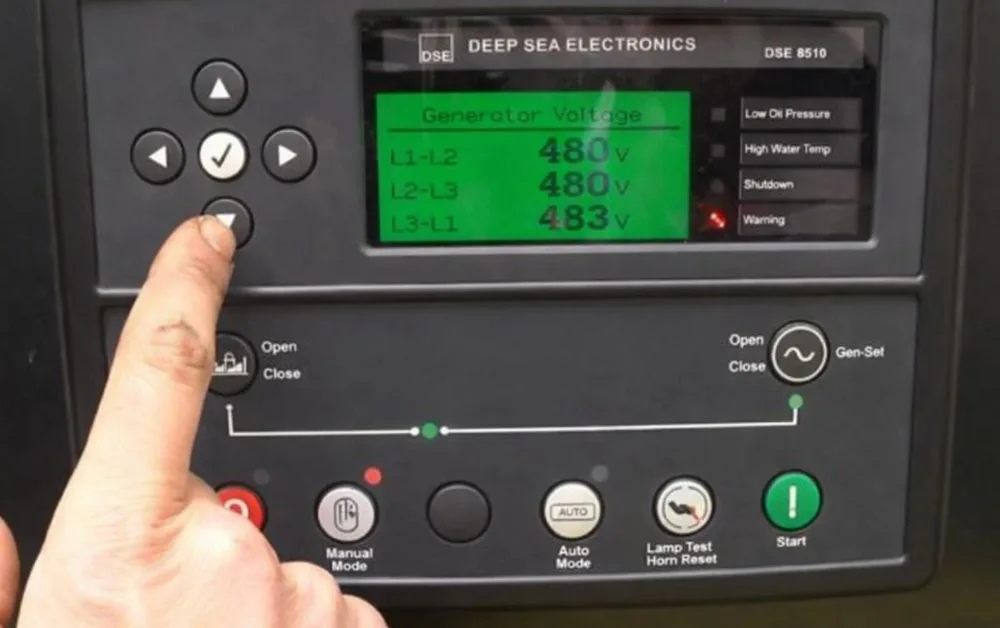

AMF Controller Functions and Performance Requirements
Automatic Mains Failure controllers are the standard specification for UAE commercial and industrial generator backup applications. An AMF controller monitors the incoming utility supply voltage and frequency continuously, and on detection of supply failure outside defined limits — voltage below threshold, frequency deviation, or complete loss of supply — initiates the generator start sequence. Modern AMF controllers start the engine, monitor the generator’s output voltage and frequency as it builds to rated values, confirm generator readiness within defined acceptance windows, issue the command to the automatic transfer switch to connect the generator to the load, and manage the stable supply-to-generator and generator-to-supply transfer sequences. The entire sequence from supply failure detection to load on generator typically completes in 10 to 15 seconds for quality AMF systems — providing power restoration within the tolerance of most sensitive loads for brief outages.
Paralleling and Synchronisation Controls
Facilities requiring N+1 or 2N generator redundancy — including UAE data centres, hospitals, and critical industrial operations — operate multiple generator sets in parallel on a common busbar, requiring control systems with synchronisation and load sharing capability beyond the capability of single-generator AMF controllers. Synchronising controls precisely match the voltage, frequency, and phase angle of the incoming generator to the busbar before the generator circuit breaker is closed — preventing the severe mechanical shock to the engine and alternator that would result from connecting an unsynchronised generator to a live busbar. Load sharing controls then distribute the total connected load equitably among all operating generators, preventing any individual unit from being overloaded while others run below their share of total demand. Diesel Generator Control Panels for parallel generator applications from specialist manufacturers including ComAp and Deep Sea Electronics provide these functions with the reliability and precision that safety-critical parallel generation requires.
Additional resources-Easy Maintenance Tips for Generator Control Panels to Keep Them Running Smoothly
Remote Monitoring and Connectivity
Contemporary UAE generator control panels incorporate Ethernet, Modbus TCP/IP, or SNMP communication interfaces that enable integration with building management systems, SCADA platforms, and dedicated generator monitoring applications. Through these connections, facility management teams can monitor real-time generator operational status including output voltage, frequency, load percentage, fuel level, engine temperature, and oil pressure from any internet-connected device without physical attendance at the generator location. For facilities managing multiple generators across multiple UAE sites, centralised remote monitoring provides continuous fleet visibility, reduces the manual inspection burden, and enables faster response to developing problems through alarm notifications that alert the facility team before a developing issue causes a service-affecting failure.

Selecting the Right Control Panel Brand
When specifying generator control panels for UAE commercial and industrial applications, confirm that the proposed panel is from an established manufacturer with a documented feature specification, a published reliability track record, UAE-based technical support capability, and firmware update programmes that extend panel functionality as building management requirements evolve. Deep Sea Electronics, ComAp, and Stamford are consistently regarded as the quality benchmarks for UAE generator control panel specifications by the leading diesel generator manufacturers in UAE, for good reasons — their products deliver the feature depth, reliability data, and regional support infrastructure that critical backup power applications require. Generic or house-brand control panels may reduce acquisition cost but introduce technical support risks that become apparent only when faults develop and specialist diagnostic assistance is needed.


